Stop Posting: Why Instagram Marketing Is Not Working for You
Is your Instagram marketing not working? Stop chasing vanity metrics and learn why shifting your budget to high-intent search can drive actual business revenue.
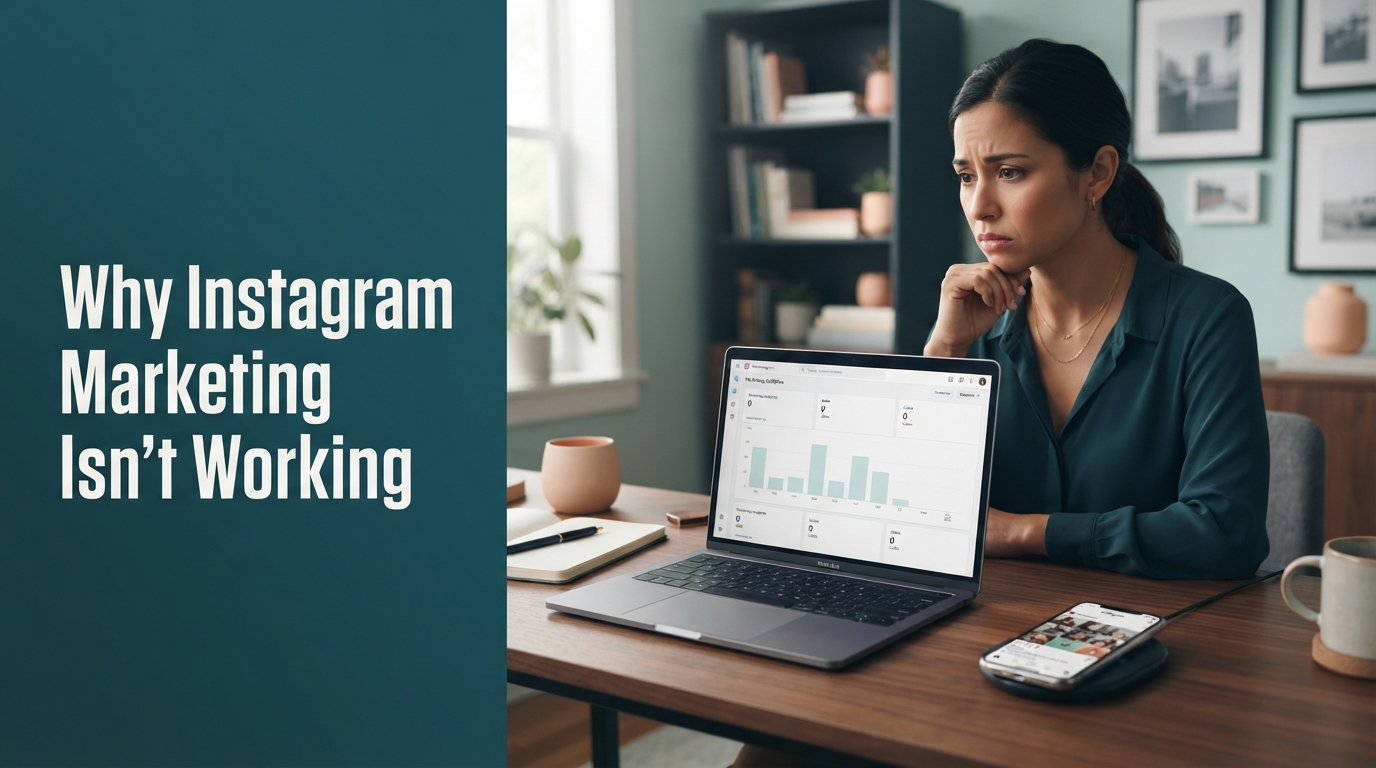
You spent 30 days grinding out Reels, editing captions, and engaging with accounts that never convert into actual revenue. If your Instagram analytics show high reach but your bank account shows zero new leads, you are suffering from the social media vanity trap. I see this daily: business owners burning their entire marketing budget on content that Google search algorithms will never see and that high-intent buyers are actively ignoring.
Why is my Instagram content not generating any leads?
Your Instagram content is failing because it occupies a 'passive consumption' space rather than a 'problem-solving' space. Users scroll Instagram to be entertained, not to hire a service provider or buy a technical solution, meaning your sales intent is fundamentally mismatched with the platform's user behavior.
To understand why this happens, consider the "scroll-to-stop" ratio. Instagram is designed to keep users in a state of continuous, mindless movement. When you inject a sales pitch into that feed, you are interrupting a dopamine loop. The user isn't looking for a solution to their problem—they are looking for a distraction from their day. Consequently, even when your content is high-quality, the psychological state of the viewer is "entertainment mode."
Contrast this with a Google search. A user typing "emergency plumber near me" or "best B2B accounting software for small business" is in "problem-solving mode." They have an immediate, burning need. When they click your link from a search result, they aren't being interrupted; they are fulfilling a goal. My experience in SEO shows that a user searching on Google has a specific problem they want to solve right now. An Instagram follower is a spectator; a Google searcher is a buyer.
When you invest time in Reels or static posts, you are essentially "renting" attention from Meta. If your content doesn't hit the algorithm's sweet spot within the first 60 minutes, it is effectively deleted from the public consciousness. Conversely, a well-optimized blog post or service page can sit in the top three positions of Google for years, generating qualified leads while you sleep. According to data from HubSpot, organic reach on social platforms has been steadily declining for years. You are essentially paying for the privilege of shouting into a digital void while the people who actually need your services are searching for solutions elsewhere. If you want to stop wasting hours, you need to shift your focus to channels where purchase intent is high.
The difference between vanity metrics and actual business revenue
Vanity metrics like likes, comments, and follower counts provide a false sense of progress that does not impact your bottom line. Actual business revenue is driven by qualified traffic, conversion rate optimization, and lifetime customer value, none of which are inherently tied to your Instagram engagement numbers.
Consider the "Influencer Illusion." I have audited hundreds of businesses that had 20,000 followers and zero net profit from their social efforts. The owner feels successful because they see a high "like" count on their posts, but those likes represent people who will never spend a dime on the business. These followers are often other business owners in the same niche, bots, or casual observers. None of these groups constitute a buyer persona for a high-ticket service.
Conversely, I have worked with boutique firms that have 500 followers but generate six figures in annual revenue through technical SEO and targeted PPC management. These businesses don't care about their Instagram aesthetic; they care about their "Call-to-Action" (CTA) conversion rates. They track how many people fill out a contact form or click the "Book Now" button. Metrics like 'impressions' are easy to inflate, but they do not pay your overhead or payroll.
Focusing on likes is a distraction from the fundamental Local SEO checklist items that actually move the needle for your business. When you obsess over an algorithm that changes every week, you ignore the long-term equity of building a brand that ranks on Google Maps or in AI-driven search results like Perplexity or ChatGPT. You are building a house on sand, while your competitors are building on the bedrock of search intent.
Why you are failing to convert followers into website visitors
Instagram is a 'walled garden' designed to keep users inside their ecosystem, which makes sending traffic to your own website friction-heavy and inefficient. Because Instagram does not prioritize outbound links in captions or posts, you are essentially asking a distracted user to jump through several hoops just to reach your landing page.
Think about the "Link-in-Bio" bottleneck. To move a user from Instagram to your site, they must:
- Stop scrolling.
- Click your profile icon.
- Click the link in your bio.
- Wait for a third-party tool (like Linktree) to load.
- Find the specific page they were interested in.
- Wait for your website to load.
Every single step in that process causes a drop-off of 30% to 50% of your potential traffic. By the time they reach your site, they are often frustrated or distracted. Even when users arrive at your site, if your UX is not optimized for speed and conversion, they will bounce immediately. We know from Google's Core Web Vitals that site performance is a ranking factor, but more importantly, it is a conversion factor. If your site is slow, your social media traffic will convert at near-zero rates.
Instead of trying to force a social audience to visit your site, you should be building web design structures that convert organic search traffic. When a user finds you on Google, they have already validated their need. They are ready to convert, provided your site does not get in the way.
| Metric | Instagram Marketing | High-Intent Search (SEO/PPC) |
|---|---|---|
| Intent Level | Low (Entertainment) | High (Transactional) |
| Sales Cycle | Long/Fragmented | Short/Direct |
| Cost per Acquisition | High (Labor/Ads) | Predictable (ROI-focused) |
| Asset Longevity | 24-48 Hours | Indefinite (Organic) |
| Primary Goal | Brand Awareness | Revenue Generation |
Is social media the wrong channel for your target audience?
Social media is the wrong channel if your business relies on 'emergency' or 'high-consideration' services where users search for solutions only when a problem arises. For industries like dentistry, legal services, or specialized B2B consulting, customers use search engines to solve problems, not social feeds to discover them.
Consider the "Emergency Threshold." If a homeowner has a burst pipe, they aren't checking Instagram to see which plumber has the best-edited Reels. They are opening Google Maps to find the closest professional with the highest rating. If you are a local business, you need to be visible where the intent is. You can learn more about how this works by reading my guide on how AI search engines choose your site.
If you are a B2B consultant, your ideal client is likely busy, professional, and looking for specific expertise. They are searching for "how to scale my SaaS revenue" or "outsourced CFO services." They are not looking for your "Monday Motivation" quote on Instagram. By spending time on social, you are effectively ignoring the very people who have the budget to hire you. If you want to understand if your business is visible in the right places, use the Google Maps Visibility Checker. If you aren't showing up there, that is where your marketing budget should be going, not toward an Instagram post that will be buried by tomorrow morning.
How to pivot your budget from social media to high-intent search
You should pivot your budget by taking the hours and dollars currently spent on content creation and reallocating them toward search engine optimization and high-intent PPC campaigns. By focusing on keywords that signal purchase intent, you capture traffic that is already looking to hire or buy.
Start by auditing your current output. If you are spending 10 hours a week filming, editing, and posting, that is 40 hours a month. At a conservative $50/hour rate, that is $2,000 in labor costs every month. Now, imagine putting that $2,000 toward a targeted Google Ads campaign for a high-value keyword. You would likely generate 10–20 high-quality leads that actually convert.
'Social media is a rental property where the landlord can change the locks whenever they want. Your website and your search ranking are the equity you own.' — Selcuk AKBAS
Transitioning from social to search is not about abandoning digital marketing; it is about choosing the channel with the best return. Check your ROI with our PPC calculator to see exactly how much your leads are costing you versus what they should cost in a high-intent environment. When you stop chasing followers and start chasing rankings, the quality of your leads will skyrocket. The transition involves three steps:
- Keyword Research: Identify the 10 terms your customers use when they are ready to buy.
- Content Mapping: Create landing pages that directly address the intent of those keywords.
- PPC Kickoff: Run ads on those specific terms to gain immediate data, then use that data to fuel your long-term SEO strategy.
Why a high-converting website is more important than Instagram likes
A high-converting website acts as your 24/7 digital sales representative, whereas an Instagram account is merely a digital billboard that users ignore. A professional, fast-loading site built on a 3-second conversion funnel will consistently outperform a massive social following in terms of real-world revenue.
Think of your website as your "Digital Storefront." If a customer walks into a retail store and it is cluttered, hard to navigate, and the staff doesn't answer their questions, they leave. The same applies to your website. A high-converting site uses clear, benefit-driven messaging, fast load times (under 1.5 seconds), and a single, obvious CTA.
Your website is the only asset you control entirely. Platforms like Instagram can shadow-ban your reach or change their algorithm overnight, but a well-optimized website with technical SEO snippets remains a reliable engine for long-term growth. When you invest in your site, you are investing in your own infrastructure rather than a third-party platform.
If you are using a site builder that hinders your SEO, consider moving toward a custom architecture. Wix vs. Squarespace vs. Custom is a debate I settle frequently; custom designs always win for local SEO because they allow for the granular technical control required to rank in competitive markets. For more on how to structure your site for authority, consult Google's Search Quality Evaluator Guidelines.
How to measure if your digital marketing is actually profitable
You measure profitability by calculating your Customer Acquisition Cost (CAC) against the Lifetime Value (LTV) of your clients, ignoring all 'vanity' metrics like reach or engagement. If you are spending $500 to acquire a customer who pays you $200, your marketing is failing regardless of how many likes you have.
To calculate this, take your total marketing spend (including labor and software) and divide it by the number of new customers acquired in a specific timeframe. If you are seeing a CAC that is higher than 25% of your customer's LTV, your channel is inefficient.
Use Google Analytics to track the entire path from the first search query to the final checkout. You need to see exactly which keywords and landing pages are driving sales. If you find your current setup is leaking potential customers, it is time to audit your strategy. Look specifically at your "Assisted Conversions" report to see if users are finding you through organic search before returning to convert.
If your site is not performing as expected, run an Agentic UX & WebMCP Auditor to identify the friction points in your funnel. Stop guessing why your marketing isn't working and start fixing the technical foundation of your business. If you are ready to stop wasting time on vanity metrics and start building a lead-generation machine, contact EchoRank today to discuss a strategy that actually drives revenue. By moving your focus from the vanity of the feed to the intent of the search bar, you move from playing a game of chance to building a predictable, scalable business.
Key takeaways
- Instagram is a passive consumption platform, making it difficult to convert users into high-intent buyers.
- Vanity metrics like likes and followers do not correlate with business revenue or profit margins.
- Search engine traffic captures users in 'problem-solving mode' who are ready to make a purchase.
- Relying on social media for leads is risky because platform algorithms can change your reach overnight.
- Reallocating marketing labor costs toward Google Ads or SEO provides a more predictable ROI for businesses.
Frequently asked questions
- How do I know if my business should quit Instagram marketing?
- If your Instagram analytics show high engagement but zero conversions or revenue, your audience is likely not in a buying mindset. Businesses offering high-consideration services, such as legal or emergency repairs, should prioritize Google search visibility over social media content to reach customers who are actively looking for solutions.
- Is it possible to get leads from Instagram without ads?
- Organic lead generation on Instagram is increasingly difficult due to declining reach and the platform's 'walled garden' design. Because users are discouraged from leaving the app, the friction to reach your website is high. Most small businesses find that the time spent creating organic content is better invested in SEO for long-term growth.
- What is the best way to track if my marketing is actually working?
- Stop tracking vanity metrics like likes and shares. Instead, calculate your Customer Acquisition Cost (CAC) by dividing your total marketing spend by the number of new customers acquired. Use Google Analytics to monitor the entire conversion path from the first search query to the final checkout to identify which channels drive actual profit.
- Why does my website need to be fast for marketing to work?
- Site speed is both a Google ranking factor and a critical conversion element. If your website takes more than 1.5 to 3 seconds to load, users will bounce, wasting the traffic you worked hard to acquire. A fast-loading, optimized site ensures that the visitors coming from search engines can easily complete a purchase or contact form.
Sources & references

Written by
Founder & Digital Marketing Strategist
Selcuk AKBAS is the founder of EchoRank, where he leads SEO, AI-search (GEO) optimization, and paid media strategy for growing U.S. businesses. Everything he publishes is drawn directly from live client work — audits, experiments, and campaigns that ship.
- Google Ads Search Certification
- Google Analytics Certification