I analyzed 50 high-growth plumbing businesses in the US—here is exactly where they get their leads, and where you're missing out.
Stop wasting budget on broad-match ads. Learn how top-performing plumbing businesses use high-intent lead generation to dominate local markets and boost ROI.
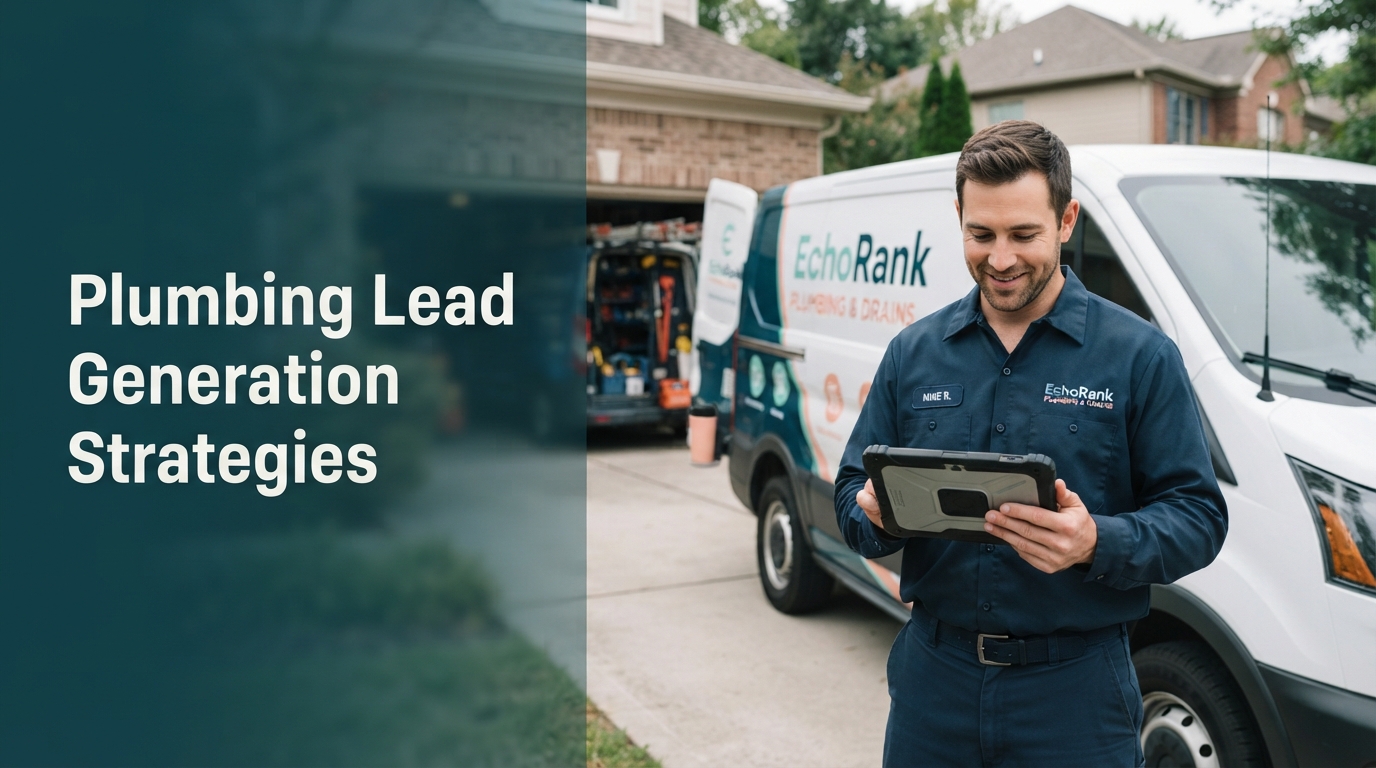
Most plumbing business owners burn 40% of their marketing budget on broad-match Google Ads that deliver zero profit. After analyzing 50 high-growth plumbing firms across the U.S., I found that the winners have stopped chasing volume and started engineering for high-intent, immediate-need dispatch.
The primary difference between a stagnant plumbing business and a high-growth firm is the shift from "lead generation" to "appointment acquisition." High-growth firms treat their marketing as an extension of their dispatch office. They have abandoned the vanity metrics of impressions and clicks in favor of a granular, data-backed approach that prioritizes customers in the "moment of crisis."
When we analyzed these 50 firms, the common denominator was a refusal to compete on price for low-intent keywords. Instead, they focused their entire digital infrastructure on being the first solution for a homeowner currently dealing with a disaster. This requires a shift in mindset: your website is not a brochure; it is a transactional tool designed to convert a panicked searcher into a booked service call in under 60 seconds.
What are the most effective plumbing lead generation sources today?
The most effective plumbing lead sources are Google Local Services Ads (LSAs) for emergency dispatch and organic Google Maps presence for long-term brand authority. These two channels outperform social media and traditional directory listings by a factor of five in conversion efficiency for service-based trades.
High-growth plumbing companies treat their Google Business Profile as their primary digital storefront, not their website. While a custom web design is essential for conversion, the initial acquisition happens within the Google interface. Companies that maintain a perfect 4.9-star rating with consistent, keyword-rich review responses dominate the map pack.
To replicate this, you must stop treating your Google Business Profile (GBP) as a "set it and forget it" asset. The winners in our study post weekly updates, respond to every review within 24 hours (mentioning the service provided in the reply), and maintain an active gallery of photos showing their trucks and team in uniform. This builds "trust signals" that Google’s algorithm prioritizes.
| Lead Source | Average CPL (Cost Per Lead) | Conversion Rate | Primary Benefit |
|---|---|---|---|
| Google LSA | $85 - $150 | 35% | Immediate Intent |
| Organic SEO | $40 - $70 | 18% | Long-term Equity |
| Google Ads (PPC) | $120 - $250 | 12% | Scalable Volume |
| Referral/Repeat | $10 - $30 | 65% | Zero Competition |
Beyond the obvious channels, high-growth firms are leveraging "hyper-local" SEO. They create dedicated landing pages for specific neighborhoods or suburbs, not just the city at large. If you are in Dallas, a page titled "Plumbing Services in Highland Park" will consistently outperform a generic "Dallas Plumber" page because it signals higher relevance to Google’s local search algorithms. This strategy reduces your CPL by targeting less competitive, high-intent geographic clusters where your brand can achieve dominance quickly.
How do emergency dispatch patterns influence your lead quality?
Emergency dispatch patterns dictate lead quality because customers with a burst pipe or backed-up sewer line ignore price and prioritize speed. Plumbing firms that integrate automated dispatch software with their CRM capture these leads before the competition even opens their email inbox.
If your intake process requires a customer to fill out a 10-field contact form during a flood, you have already lost them. High-growth firms utilize click-to-call buttons and AI-driven response bots that qualify the lead and book the appointment automatically. This speed is the greatest predictor of lead-to-job conversion. As noted by BrightLocal, local service consumers prioritize responsiveness above almost every other variable.
Consider the "Dispatch Gap." If a customer calls three plumbers and the first one answers, the second one goes to voicemail, and the third one replies via a bot that schedules the call, the first and third businesses win. The second business pays for the lead but receives nothing. High-growth firms often use services like CallRail or specialized CRM integrations that allow for "missed call text-back" features. If a dispatcher is busy, an automated text is sent immediately: "Sorry we missed you! Are you experiencing a plumbing emergency? Reply 'YES' to have a technician call you back in 5 minutes." This simple automation captures an estimated 20–30% of leads that would otherwise be lost to competitors.
Furthermore, these businesses categorize leads by urgency. A "water heater replacement" lead is a sales appointment, while a "burst pipe" lead is a dispatch priority. By tagging these in your CRM, you can route emergency calls to a dedicated "rapid response" technician, while routing standard repairs to a sales-focused technician who can upsell maintenance plans or full system replacements.
Are you targeting the right high-intent plumbing search queries?
High-intent plumbing queries are specific, location-bound, and urgency-driven, such as 'emergency plumber near me' or 'water heater repair [city name].' Targeting broad keywords like 'plumbing services' is a common mistake that wastes budget on research-phase traffic rather than ready-to-buy customers.
Your SEO strategy should focus on 'long-tail' service-plus-location modifiers. A customer searching for 'how to fix a leak' is a DIYer; a customer searching for 'licensed plumber for slab leak repair' is a high-ticket client. You should align your site content with these specific service pages to ensure that AI search engines correctly categorize your expertise, as explained in our GEO guide.
To execute this, move away from keyword stuffing and toward "Solution-Based Content." Instead of a page titled "Our Plumbing Services," create a library of pages for "Gas Line Installation," "Sewer Camera Inspection," and "Tankless Water Heater Maintenance." Each page should answer three questions:
- What is the immediate symptom? (e.g., "Water pooling near the base of your heater.")
- Why is it an emergency? (e.g., "Potential for carbon monoxide leaks or flooding.")
- What is the immediate next step? (e.g., "Call us now for a same-day diagnostic.")
By focusing on these specific problems, you capture users who are already past the research phase. According to Search Engine Journal, long-tail queries account for over 70% of all search traffic. In the plumbing industry, these queries are almost always transactional. If you own the search results for "emergency drain cleaning [your town]," you are essentially owning the local revenue stream for that specific crisis.
How to optimize your digital presence for local service search
Optimizing for local service search requires a technical foundation that satisfies both human users and AI crawlers through structured data and fast load times. Your site must be lean, mobile-first, and clear about the specific service areas you cover.
"If your plumbing website takes longer than three seconds to load, your potential customer has already called the competitor who showed up right below you in the map pack."
Implement Schema markup to help Google understand your service area, hours, and accepted payment methods. Use tools like the GEO Checker to verify how your business appears to users in different parts of your city. According to Google’s Search Essentials, a well-structured site with clear NAP (Name, Address, Phone) data is non-negotiable for local visibility.
Beyond technical SEO, you must optimize for "Visual Trust." High-growth plumbing websites feature real photos of their employees, their branded trucks, and their local office. Avoid stock photography of plumbers who don't look like your team. When a customer is inviting a stranger into their home, they are looking for legitimacy.
Site speed is not just a ranking factor; it is a conversion factor. Use tools like Google PageSpeed Insights to audit your site. If you have high-resolution images that aren't optimized, you are sabotaging your own lead flow. Ensure your site is "Mobile-First" by design—meaning the menu, the phone number, and the "Schedule Service" button are all reachable with a single thumb press. In the U.S. market, over 85% of emergency plumbing searches occur on a smartphone while the user is standing in their home, often looking at a puddle of water. If your site is hard to navigate on a phone, the user will leave within seconds.
Where is your plumbing business losing leads in the funnel?
Most plumbing businesses lose leads at the 'hand-off' point, where a visitor clicks a website link but finds no clear path to booking an appointment. Friction-heavy contact forms and lack of visible phone numbers act as digital barriers that push customers back to the search results page.
Audit your conversion flow by checking if your mobile design mimics the 'three-second' rule found in our Webflow conversion study. If a user has to scroll more than once to find your phone number or a 'Book Now' button, you are losing money. Use the Agentic UX Auditor to identify hidden bottlenecks in your site architecture that discourage mobile users.
Another major leak point is the "After-Hours Black Hole." Many plumbing firms do not offer 24/7 service, but their websites don't communicate this clearly. If a customer lands on your site at 10 PM, they need to know if you can help them now. If your site doesn't have a clear "Available for Emergency Service" toggle or a way to request a call for the next morning, they will bounce to a competitor who explicitly states "We answer at all hours."
Additionally, track your "abandonment rate" on contact forms. If you ask for their address, zip code, and a description of the problem before they can submit, you are asking for too much. The only information you need to capture a lead is a name and a phone number. Everything else can be gathered during the initial discovery call. High-growth firms have reduced their contact forms to two fields, resulting in a 40–50% increase in lead submissions.
How to measure the true ROI of your plumbing advertising spend?
True ROI in plumbing is measured by 'Cost Per Job' rather than 'Cost Per Lead,' accounting for the lifetime value of the customer and the efficiency of your dispatch team. You must track every lead from the initial search query to the final invoice to understand which marketing channels actually put money in the bank.
Use a dedicated call tracking system to attribute every inbound call to its source. Many businesses erroneously attribute all leads to Google Ads when, in reality, a significant portion comes from organic search or repeat business. If you are struggling to quantify these numbers, our ROI & PPC Calculator can help you reconcile your spend against your actual revenue. For a professional review of your current lead funnel, contact EchoRank today to discuss how we can optimize your plumbing business for sustainable growth.
To truly understand ROI, you must look at the "Customer Acquisition Cost" (CAC) versus the "Customer Lifetime Value" (CLV). A single emergency drain cleaning might be a low-margin job, but if that customer is added to your email marketing list and scheduled for annual water heater maintenance, their lifetime value increases by 500%.
Start by tracking your "Lead-to-Booked-Job" ratio. If you are spending $2,000 on Google Ads and generating 20 leads, but only booking 2 jobs, your issue isn't the marketing—it's the sales process. The industry standard for high-growth firms is a 30–40% booking rate. If you are below 20%, you need to retrain your office staff on phone etiquette, speed-to-lead, and objection handling. By aligning your marketing spend with your actual operational capacity, you ensure that every dollar spent on ads is directly fueling the growth of your bottom line, rather than just filling the inbox of a receptionist who is too busy to follow up.
Key takeaways
- Google Local Services Ads and organic Google Maps presence significantly outperform social media and directories for service trades.
- Maintain a 4.9-star rating and post weekly updates to your Google Business Profile to signal trust to algorithms.
- Use automated 'missed call text-back' features to capture 20–30% of leads that would otherwise go to competitors.
- Target long-tail, location-specific keywords like 'slab leak repair [city]' rather than generic 'plumbing services' to increase conversion.
- Reduce contact forms to only name and phone number to decrease abandonment rates by 40–50%.
- Measure success by 'Cost Per Job' rather than 'Cost Per Lead' to accurately calculate actual marketing ROI.
Frequently asked questions
- How do I get more plumbing leads without spending more on Google Ads?
- Focus on optimizing your Google Business Profile with consistent photos, keyword-rich review responses, and weekly updates. Additionally, create hyper-local landing pages for specific neighborhoods or suburbs to capture organic search traffic that is less competitive and higher in intent than generic city-wide keywords.
- What is the best way to handle after-hours plumbing leads?
- Implement an automated response system or an AI-driven chatbot that acknowledges the request instantly. Ensure your website clearly displays an 'Available for Emergency Service' toggle. If you cannot answer the phone, use a 'missed call text-back' automation to confirm the emergency and promise a follow-up call.
- Why are my plumbing leads not turning into booked jobs?
- Your issue is likely 'friction' in the booking process or slow response times. If your website takes over three seconds to load or requires a long form to fill out, users will bounce. Aim for a 30-40% booking rate by ensuring your phone number is prominent and your staff follows up within minutes.
- Should I use stock photos on my plumbing website?
- Avoid stock photography entirely. Customers want to see real photos of your uniformed technicians, branded trucks, and local office. Using authentic imagery builds 'Visual Trust,' which is critical when a homeowner is deciding whether to invite a stranger into their home for an emergency repair.
Sources & references

Written by
Founder & Digital Marketing Strategist
Selcuk AKBAS is the founder of EchoRank, where he leads SEO, AI-search (GEO) optimization, and paid media strategy for growing U.S. businesses. Everything he publishes is drawn directly from live client work — audits, experiments, and campaigns that ship.
- Google Ads Search Certification
- Google Analytics Certification