Why Your Site Disappeared from Search Engines (And How to Fix It)
Traffic dropped? Learn how to perform manual action recovery, identify Google penalties, clean up toxic backlinks, and submit a successful reconsideration request.
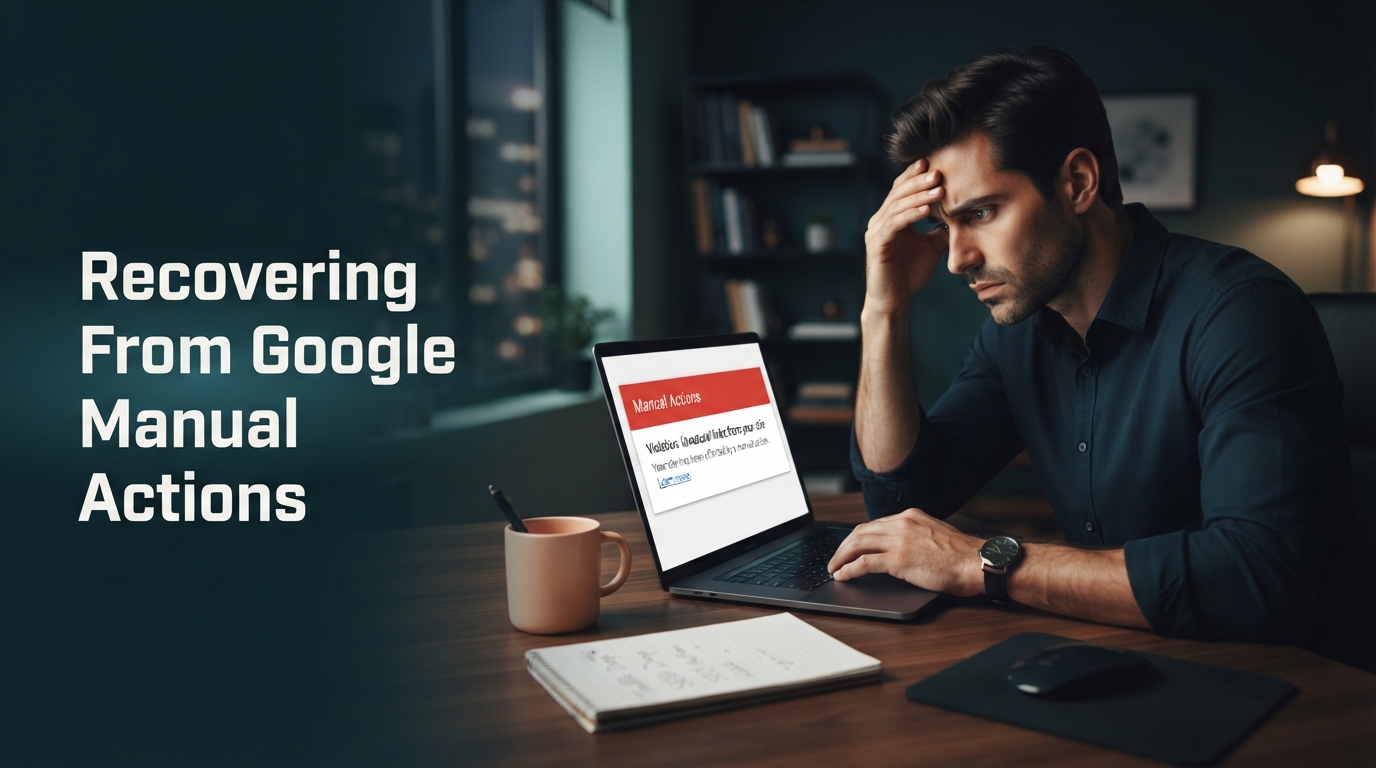
Seeing your organic traffic plummet overnight is the digital equivalent of waking up to a boarded-up storefront. When your rankings vanish, the immediate panic often masks the reality that search engines are rarely acting out of malice; they are enforcing quality standards that you likely breached, whether intentionally or through technical negligence. As a practitioner, I have spent years helping businesses navigate the grueling process of manual action recovery to restore their digital footprint.
How do I know if my website has a manual action penalty?
The only definitive way to confirm a manual action is by checking the 'Manual Actions' report within Google Search Console. If Google has penalized your site, you will see a specific notification detailing the issue, the affected pages, and the reason for the enforcement.
When you open the 'Manual Actions' tab, you are looking for one of two statuses: either a clean bill of health or a list of specific violations. If you see a notification, Google has essentially flagged your domain for behavior that violates their spam policies. This is a binary state; you are either under enforcement or you are not.
If the report says 'No issues detected,' your traffic drop is likely algorithmic rather than manual. Many business owners confuse the two, but an algorithmic update—like a core update or a shift in how AI search engines process data—requires a different strategy. If you suspect your issue is related to modern search shifts rather than a penalty, review our guide on why your company isn't showing up in ChatGPT to rule out AI-driven visibility gaps.
Algorithmic drops are often characterized by a gradual or sudden decline following a Google update announcement, whereas manual actions usually trigger a sharp, vertical drop in visibility. If your site has disappeared from the index entirely, check the 'Removals' tool and the 'URL Inspection' tool in Search Console to see if your pages are still indexed. If they are indexed but not ranking for branded keywords, you are likely facing a quality-based algorithmic filter. If your pages are de-indexed, you are likely facing a severe manual action or a significant technical misconfiguration.
Why did Google issue a manual action against my domain?
Google issues manual actions when a human reviewer determines that a site violates their Webmaster Guidelines, typically through spammy link building, cloaking, or thin content. These penalties are designed to protect the integrity of the search index by removing sites that prioritize manipulation over user value.
Understanding the "why" requires looking at your site through the eyes of a search quality evaluator. These human reviewers are trained to identify sites that attempt to game the system. If you have been relying on "shortcut" SEO tactics—such as purchasing thousands of low-quality links from overseas blog networks or hiding text in white-on-white CSS—you have triggered a flag.
Common triggers include:
- Unnatural inbound links: This is the most common manual action. It occurs when your backlink profile shows a high concentration of paid, automated, or irrelevant links that clearly violate Google's link spam policies.
- Cloaking: Serving different content to the Googlebot than you do to a human user is a direct violation of trust. This is often used by malicious actors to redirect users to landing pages they didn't intend to visit.
- Thin content: If 70% of your site consists of automated, AI-generated, or scraped content that provides no additional value to the user, Google will eventually flag the domain as "low-value."
- User-generated spam: If your blog comment sections or forum pages are filled with links to casino or pharmaceutical sites, Google holds you responsible for the maintenance of your own site.
If you have been aggressively building links or relying on black-hat tactics, you have likely crossed the line. You can compare your recent site activity against industry standards using our SEO services to determine if your tactics have become obsolete or dangerous. Often, small business owners outsource SEO to agencies that promise "thousands of backlinks for $500." These low-cost services are almost always the culprit behind a manual action penalty.
How to perform a technical audit to identify policy violations
A comprehensive technical audit involves crawling your site with tools like Screaming Frog or Ahrefs to identify broken redirects, hidden pages, and thin content clusters. You must compare your current site structure against Google's Search Essentials to ensure every page provides a distinct, helpful purpose.
The audit is not just about finding errors; it is about documenting a clean slate. You need to prove to Google that you have identified the source of the rot and excised it.
Audit Steps:
- Indexation Review: Use the 'Pages' report in Google Search Console to find blocked URLs. If you see a high number of "Crawled - currently not indexed" pages, it indicates that Google has deemed your content unworthy of inclusion.
- Security Check: Scan for malware or hacked content that might be triggering a 'deceptive site' penalty. Hackers often inject hidden scripts or redirect your traffic to phishing sites; Google will penalize you for this even if you are the victim.
- Link Profile Analysis: Audit your backlink profile using SEMrush or Ahrefs. Look for "toxic" domains—sites with zero traffic, high spam scores, or unrelated subject matter—that are linking to your site in bulk.
- Content Audit: Export your site’s URLs into a spreadsheet. Categorize them by word count, organic traffic, and conversion rate. Any page with low word count and zero traffic is a prime candidate for pruning.
If your site is struggling with conversion alongside visibility, you might benefit from our proprietary UX architecture to ensure that once visitors arrive, they actually stay.
| Issue Type | Estimated Fix Time | Recovery Probability | Severity |
|---|---|---|---|
| Thin Content | 2–4 Weeks | High | Moderate |
| Spammy Backlinks | 3–6 Months | Moderate | High |
| Cloaking/Hacking | 1–2 Weeks | Very High | Critical |
| Keyword Stuffing | 1–3 Weeks | High | Low |
What is the correct process for submitting a reconsideration request?
A reconsideration request is a formal appeal submitted through Google Search Console after you have documented and implemented every necessary fix. You must provide a clear, concise explanation of what went wrong, the steps you took to correct the violations, and how you will prevent future occurrences.
When writing your request, treat the Google reviewer like a judge. Provide a brief, professional summary. Do not use emotional language or make excuses about not knowing the rules. If you were the victim of negative SEO, explain the steps you took to disavow those links. If you were guilty of buying links, explain that you have ceased that practice and provide evidence of the links you have removed or disavowed.
According to Google's official documentation, the review process can take several days to several weeks. During this time, do not submit multiple requests, as this can delay the process. Ensure your documentation is attached as a PDF or spreadsheet, showing exactly which links were removed and which pages were updated.
"Manual action recovery isn't just about cleaning up the past; it is about rebuilding your site's reputation from the ground up to align with Google's E-E-A-T standards." — Selcuk AKBAS
How to clean up toxic backlinks and thin content effectively
Cleaning up toxic links requires a systematic approach using the Google Disavow Tool to tell Google to ignore specific low-quality domains. For thin content, the most effective strategy is either to delete the pages entirely, canonicalize them to a stronger parent page, or significantly rewrite them to provide genuine user utility.
When dealing with toxic backlinks, remember that Google prefers you try to remove them manually first. This means emailing the webmasters of the spam sites. While most will ignore you, having a record of these emails is vital for your reconsideration request. For the links you cannot remove, the Disavow Tool is your secondary defense.
The Cleanup Workflow:
- Identify: Export your backlink list. Sort by 'Spam Score' or 'Toxic Score' in your SEO tool of choice. Look for patterns, such as thousands of links coming from a single root domain or a specific TLD (like .xyz or .ru) that has no relevance to your business.
- Outreach: Send a standardized, polite email to the site owners. "I am currently cleaning up my backlink profile and noticed links from your site to mine that violate Google's guidelines. Please remove these." Keep a log of these requests.
- Disavow: Create a
.txtfile with one domain per line, prefixed withdomain:. Upload this to the Google Disavow Tool. Be conservative; do not disavow high-quality, legitimate links just because they are "weak." - Prune: For thin content, if a page doesn't serve a user, it shouldn't exist. If you have 50 pages about slightly different variations of a service you offer, combine them into one authoritative, high-quality pillar page and 301-redirect the others. This consolidates your link equity and removes the "thin" signal.
How long does manual action recovery take after a fix?
Manual action recovery typically takes between two weeks and three months, depending on the severity of the violation and the thoroughness of your cleanup. Once Google reviews your request and lifts the penalty, your rankings will not bounce back instantly; you must rebuild your authority through consistent, high-quality content and clean technical practices.
The "recovery" phase is often the most frustrating part for small business owners. Even after the manual action is lifted, your site has lost the "trust" of the algorithm. You are effectively starting from a lower baseline. You must focus on creating high-quality, original content that satisfies user intent. If you were penalized for spam, Google will be watching your site closely for the next 6 to 12 months.
Google needs time to re-crawl your pages and verify that the site is now compliant. During this 'waiting period,' focus on improving your technical SEO to ensure your infrastructure is bulletproof. Ensure that your site speed, core web vitals, and mobile responsiveness are optimized, as these factors provide a positive signal to Google that your site is now a high-quality destination for users. Remember that even after a penalty is lifted, your site may not return to its previous positions if the competitive landscape has shifted toward AI-integrated search results. You must pivot toward answering the user's question faster and more comprehensively than your competitors.
Preventing future penalties through professional technical SEO
Preventing future penalties requires an ongoing commitment to technical health, including regular audits of your backlink profile and strict adherence to content quality guidelines. By keeping your site lean, secure, and fast, you minimize the surface area for potential violations.
True SEO sustainability is about risk mitigation. You should perform a "mini-audit" of your backlink profile every quarter. If you see a sudden influx of spammy links, you can disavow them proactively before they reach a critical mass that triggers an automated or manual flag. Similarly, ensure that your content team is trained on the difference between "helpful content" and "keyword-stuffed content."
Focus on building a site that users love and that satisfies modern search intent. If you are uncertain about your current standing or need a professional assessment of your site's health, contact our team today to initiate a full technical audit and ensure your site is built to survive the next generation of search updates. For further reading on the intersection of modern search and site health, consult Google's Search Quality Evaluator Guidelines, which provide the blueprint for the standards you are now expected to uphold. By shifting your mindset from "ranking at all costs" to "providing the best possible user experience," you effectively future-proof your domain against both manual and algorithmic volatility.
Key takeaways
- Confirm manual actions exclusively through the Manual Actions report in Google Search Console.
- Manual actions cause sharp, vertical traffic drops, whereas algorithmic updates often result in gradual declines.
- Prioritize removing spammy backlinks manually before using the Google Disavow Tool.
- Consolidate thin, low-value content into high-quality pillar pages to improve site authority.
- Recovery typically takes two weeks to three months after submitting a successful reconsideration request.
Frequently asked questions
- Can I get a manual action removed without deleting all my bad links?
- Google expects a good-faith effort to remove toxic links manually by contacting site owners. If you cannot get them removed, you must document your outreach attempts and then use the Google Disavow Tool to tell Google to ignore the remaining problematic links. Simply ignoring the links will likely lead to a rejected reconsideration request.
- Will my rankings return to normal immediately after a penalty is lifted?
- No, your rankings will not bounce back instantly. Once the penalty is lifted, your site must rebuild its trust and authority with Google. You are essentially starting from a lower baseline and must focus on consistent, high-quality content and technical excellence to regain your previous positions over the following months.
- How do I know if my traffic drop is a penalty or just a bad update?
- Check the Manual Actions report in Google Search Console. If it says 'No issues detected,' your drop is likely algorithmic. Algorithmic drops usually correlate with Google update announcements and show gradual changes, while manual actions appear as a sudden, vertical drop in visibility following a specific policy violation.
- What should I include in my reconsideration request to Google?
- Your request must be professional and factual. Explain exactly what went wrong, detail the specific steps you took to fix the violations, and provide evidence—such as a spreadsheet of removed links or updated content—that the site is now compliant. Avoid emotional language and focus on your commitment to future quality.
Sources & references

Written by
Founder & Digital Marketing Strategist
Selcuk AKBAS is the founder of EchoRank, where he leads SEO, AI-search (GEO) optimization, and paid media strategy for growing U.S. businesses. Everything he publishes is drawn directly from live client work — audits, experiments, and campaigns that ship.
- Google Ads Search Certification
- Google Analytics Certification