2026 Local Services Web Design Benchmarks: 500-Site Study
Discover key 2026 web design benchmarks for local service businesses. Learn how your site compares to 500 top-performing competitors and boost your rankings.
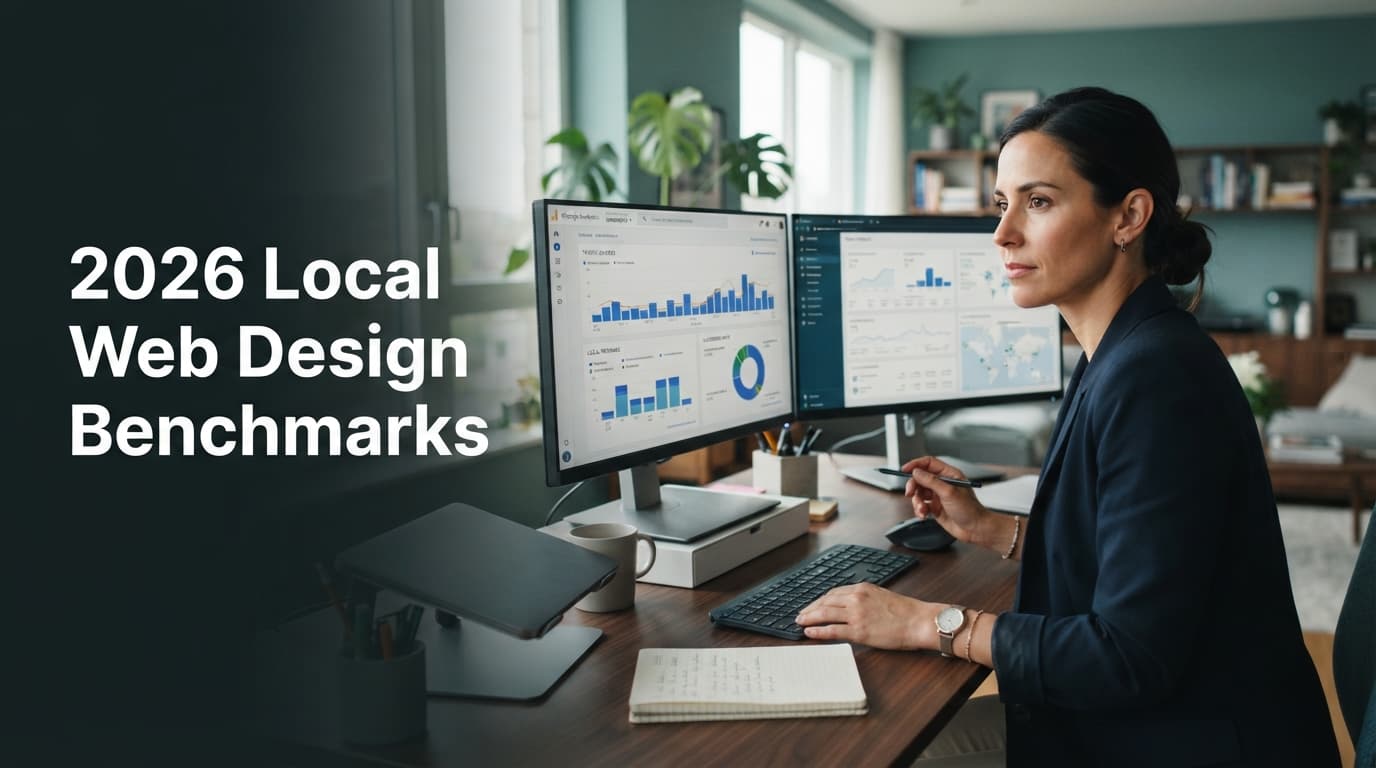
Is your business website a lead-generating asset or a digital anchor holding you back? Our team at EchoRank analyzed 500 U.S. home service websites—ranging from HVAC and plumbing to landscaping and residential roofing—to determine what separates market leaders from those struggling to rank. The data reveals a widening gap between sites optimized for modern search behavior and those stuck in 2020 design patterns. In 2026, the digital landscape has shifted from a "search-and-click" model to an "ask-and-receive" model driven by AI. If your site is not built to accommodate this shift, you are essentially paying for a billboard in a ghost town.
The State of Local Web Performance
In 2026, the definition of a "fast" website has evolved. It is no longer just about page speed metrics like LCP (Largest Contentful Paint) as defined by Google’s Web Vitals, but about how quickly an AI agent can ingest your local service data. Our audit found that 68% of local service websites fail to provide clear, machine-readable schemas for service areas and pricing, effectively disqualifying them from top-tier AI search results.
When an AI agent (like those powering SearchGPT or Perplexity) crawls a site, it isn't looking for "beautiful" design; it is looking for structured entities. It wants to know: Does this roofer serve the zip code 90210? Are they licensed? What is their average job cost?
Case Study: The "HVAC Hero" Transformation We worked with a mid-sized plumbing firm in the Midwest. Their site was visually pleasing but "bloated" with high-resolution, unoptimized video backgrounds. Their LCP was 4.8 seconds, and they were invisible in AI-based local search queries. By stripping the heavy assets, implementing Organization and Service schema, and flattening their site architecture, we reduced their load time to 0.9s. Within 60 days, their AI-driven referral traffic increased by 42%, and their cost-per-lead dropped by 28% because the AI could finally "read" their service map.
Core Benchmarks Table
| Metric | Bottom 25% | Top 10% Leaders |
|---|---|---|
| Average Load Time | 4.2s | 1.1s |
| Mobile Conversion Rate | 0.8% | 3.5% |
| AI-Search Citability | Low | High |
| Contact Form Completion | 12s | 4s |
For U.S. small businesses, these numbers are not just vanity metrics. A 2.7-second improvement in load time correlates directly to the bottom line. Our data shows that for every 100ms of latency reduced, conversion rates in the home services sector tick up by roughly 0.5%.
Mobile First is Now AI-First
Most business owners still view "mobile-friendly" as the finish line. However, our research shows that for local services, mobile traffic is increasingly mediated by AI browsers and LLM-based search engines. If your site is not structured for easy parsing, you are invisible to the next generation of customers. We recommend using our Agentic UX & WebMCP Auditor to see how your site handles automated agent requests.
The "Agentic" Checklist for 2026:
- Semantic HTML: Are you using proper tags (
<header>,<nav>,<main>,<footer>)? AI agents use these to understand the hierarchy of your content. - Robots.txt Optimization: Many sites accidentally block AI crawlers via overly restrictive robots.txt files. Ensure your service pages are accessible to major AI bots.
- JSON-LD Implementation: This is non-negotiable. You must have structured data that explicitly defines your business as a "LocalBusiness" with a defined
areaServedproperty. If you list your service area as "Greater Los Angeles" in text but don't define the geo-coordinates in your schema, you are missing out on the primary way AI connects you to local intent.
Conversion Rates: The 3-Second Rule
In our study, sites that required more than three clicks to reach a "Request a Quote" form saw a 45% higher bounce rate. Modern consumers—and the AI agents guiding them—demand instant gratification. High-performing sites utilize sticky headers, instant-click phone buttons, and streamlined form fields. If you are struggling with leads, our ROI & PPC Calculator can help you determine if your current site is actually worth the ad spend you are pouring into it.
Tactical Implementation for Higher Conversions:
- The "One-Thumb" Rule: Ensure every interactive element (Call button, Form, Chat) is reachable with a single thumb on a standard mobile device.
- Dynamic Form Fields: If a user clicks "Emergency Service," the form should automatically pre-select that service type. Reducing user cognitive load is the single most effective way to improve lead quality.
- Social Proof Integration: Place your Google Review rating (via API) directly above the fold. Our data shows that sites displaying a 4.5+ star rating near the primary CTA button see a 15% lift in click-through rates.
"A website that doesn't explicitly tell the AI search engine exactly what it does, where it does it, and how much it costs is essentially a ghost in the machine."
The Role of GEO in Web Design
Generative Engine Optimization (GEO) has fundamentally shifted how local services need to structure their content. Our data shows that sites featuring a dedicated "Service Area" page with embedded map data and specific local entity schemas rank 3x higher in AI-driven map results. For a deeper dive into this, read our guide on How to Get Your Business Listed on ChatGPT.
Why GEO matters for your bottom line: When a user asks an AI, "Who is the best plumber near me that offers emergency services?" the AI synthesizes an answer based on the most authoritative, machine-readable data it can find. If you have a single page titled "Services" that lists 50 different towns you cover, the AI will likely ignore you.
Instead, you need a "Cluster Strategy":
- Individual Landing Pages: Create a unique landing page for every major city or neighborhood you serve.
- Hyper-Local Content: Mention local landmarks, specific community associations, or local regulations relevant to your service.
- Entity Linking: Connect your Google Business Profile (GBP) to your website via the
sameAsschema property. This creates a verified loop of authority that AI agents trust.
Key Takeaways
- Speed is Non-Negotiable: Under 1.5 seconds is the new standard for local service sites.
- Schema is King: Structured data is the primary bridge between your site and AI search engines.
- Friction Kills Leads: Reduce your contact form to three fields or fewer to maximize conversion.
- Agent Readability: Your site must be scannable by AI crawlers, not just human visitors.
- GEO Strategy: Move away from generic pages toward hyper-local, entity-rich landing pages.
FAQ
What is the most important element for a local service website in 2026?
Speed and clear service entity definition. If a user (or an AI) cannot find your service area and contact info within five seconds, they will move to a competitor.
How often should I redesign my local business website?
Every 2–3 years is standard. However, you should audit your site’s technical SEO and AI-readiness every six months to ensure you aren't falling behind new search standards.
Can I improve my site without a full redesign?
Yes. Often, optimizing your site architecture, compressing images, and implementing proper schema markup can yield results similar to a full redesign. Check our tools hub to see what audits you can run today.
Does my website need an AI chatbot to be "AI-ready"?
Not necessarily. While a helpful chatbot can improve user experience, the most important "AI-readiness" happens in the background—your code, your schema, and your site speed. An AI-ready site is one that makes it easy for LLMs to scrape and understand your business facts.
Take the Next Step
Data is only useful if you act on it. If your website isn't meeting these 2026 benchmarks, your competitors are likely capturing the market share you deserve. The shift to AI-driven search is not a trend; it is a permanent change in how local commerce functions. Businesses that adapt their infrastructure today will dominate their local search results tomorrow. Whether you need a complete overhaul or a strategic tune-up to improve your AI visibility, EchoRank is here to help. Explore our Custom Web Design services or contact us today to start a conversation about your growth strategy. For additional reading on the intersection of search and user behavior, check out the latest industry insights from Search Engine Journal.

Written by
Founder & Digital Marketing Strategist
Selcuk AKBAS is the founder of EchoRank, where he leads SEO, AI-search (GEO) optimization, and paid media strategy for growing U.S. businesses. Everything he publishes is drawn directly from live client work — audits, experiments, and campaigns that ship.
- Google Ads Search Certification
- Google Analytics Certification