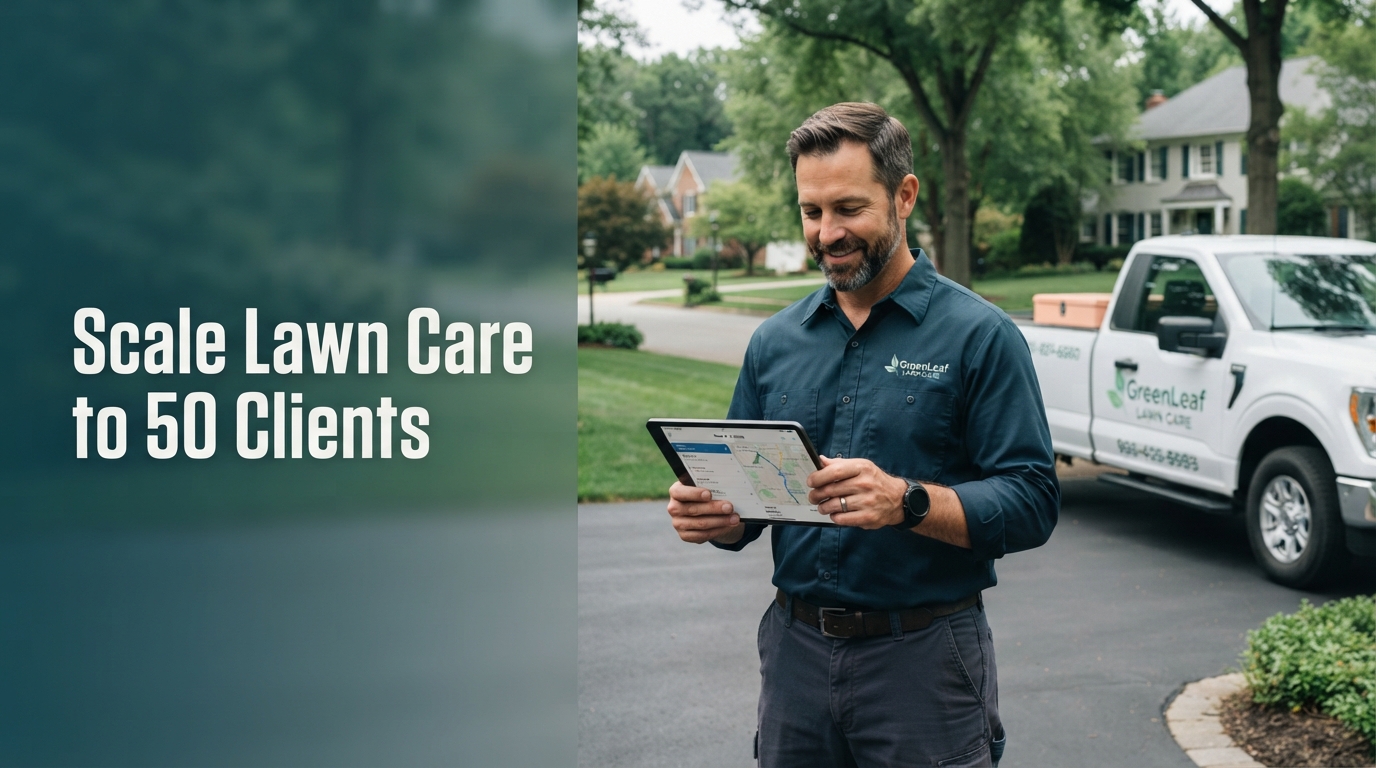
Stop cold-calling homeowners. Here is the exact blueprint I used to scale from 5 to 50 local lawn care clients in one season.
Stop cold-calling for lawn care. Use this proven blueprint to scale from 5 to 50 clients using neighborhood density, referral loops, and local SEO strategies.
Cold calling homeowners to sell lawn care is a race to the bottom where you compete on price against every neighborhood teenager with a mower. In my experience, relying on outbound dialing creates a high-churn, low-trust business model that prevents you from scaling to premium, recurring maintenance contracts.
Why does cold calling fail for modern lawn care businesses?
Cold calling fails because it treats a high-trust service like a commodity, ignoring the fact that homeowners prioritize reliability and aesthetics over a random pitch. It forces you into a low-value position where you are viewed as an interruptive solicitor rather than a professional property manager.
When you cold call, you are essentially interrupting a homeowner’s dinner or downtime to sell them on a service they have likely already outsourced or are currently "managing" themselves via a neighbor’s kid. This creates an immediate psychological barrier. Because lawn care involves granting access to private property, homeowners are inherently wary of unvetted, door-to-door, or phone-solicited contractors.
Most homeowners today rely on digital validation before letting a contractor on their property. According to BrightLocal, 98% of consumers read online reviews for local businesses, meaning your cold call is likely being followed by a Google search that confirms you don't exist online. When you cold call, you lose the chance to present your brand as the expert choice, instead becoming just another distraction during their dinner hour.
To scale from 5 to 50 clients, you must shift from "selling" to "becoming the neighborhood standard." In a typical small-business scenario, a cold caller might make 100 calls to get 2 appointments, often leading to a "price-shopper" client who will fire you the moment a cheaper option appears. Conversely, a client acquired through reputation or neighborhood density is 4x more likely to sign a full-season contract because they have already seen your work on their neighbor's lawn. By abandoning cold calls, you reclaim 10–15 hours of your week—time that should be spent on high-margin tasks like equipment maintenance, route optimization, or refining your digital footprint.
How do I build a referral loop that works for lawn care?
The most effective referral loop is a 'neighborhood density' strategy that incentivizes existing clients to act as your local sales team by offering tiered service credits. By clustering your clients on the same street, you reduce travel time and create a 'social proof' effect where neighbors hire you simply because they see your truck in the driveway daily.
Instead of asking for referrals, bake them into your operations. If a client refers a neighbor who signs a seasonal contract, offer the original client one free month of service. This creates a high-incentive loop that lowers your customer acquisition cost (CAC) significantly compared to paid ads. When your trucks are visible on every lawn on one block, your brand becomes the default local authority.
To execute this, implement a "Block Captain" program. When you land one client on a street, leave a professional, high-quality door hanger on the five houses immediately surrounding them. The copy should be simple: "We’re already taking care of the [Neighbor's Last Name] residence at [Address]. We have an opening in our schedule for your route on Tuesday mornings. Scan here for a 10% neighborhood discount." This shifts the narrative from "solicitation" to "logistical efficiency."
| Strategy | Cost per Acquisition | Lead Quality | Time to Scale |
|---|---|---|---|
| Cold Calling | $150+ (Labor/Time) | Low | Slow |
| Neighborhood Referrals | $20 (Credit Cost) | High | Fast |
| Google Ads/PPC | $60-$120 | Medium | Immediate |
| SEO/GEO Strategy | $0 (Long-term) | Very High | Long-term |
This strategy works because it leverages the "herd mentality." If you service 50% of the homes on a single cul-de-sac, you aren't just a lawn care guy; you are the neighborhood's utility provider. Your travel time drops to near-zero, your fuel costs plummet, and your profit margins per hour of labor increase drastically.
What are the best local partnerships for recurring lawn care leads?
Partnering with local real estate agents and property managers is your most profitable move because they control the 'onboarding' of new homeowners who need recurring landscaping services. These partners require reliable vendors, so providing consistent, high-quality work allows you to become their go-to recommendation for every closing.
Don't just hand out business cards. Approach a local realtor and offer to provide a 'curb appeal' audit for their listings. By helping them make the property look better for open houses, you gain access to the new homeowner before they even move in. This is a recurring lead source that, much like the strategies I discuss in my plumbing lead generation analysis, relies on building a network of high-intent referral partners rather than chasing individual prospects.
Real estate agents are constantly looking for vendors who make them look good. If a house has an overgrown lawn, it’s a liability for the agent. If you can provide a "pre-listing cleanup" within 24 hours of their request, you have just solved a major pain point for them. In exchange, ask that they include your information in their "New Homeowner Welcome Packet." This packet is essentially a curated list of trusted professionals that new owners use to set up their home services, effectively bypassing the competitive "Google search" phase entirely.
Beyond realtors, target local property management firms that handle rental properties. These managers hate dealing with lawn complaints from tenants. If you can provide a "set it and forget it" service where you bill them monthly and provide photo evidence of the completed work, you will quickly become their preferred vendor for their entire portfolio. This moves you from a single-client acquisition model to a multi-property contract model, which is the fastest way to hit that 50-client goal.
The secret to scaling isn't doing more marketing; it is building a system where your existing service becomes a persistent, physical advertisement that neighbors feel compelled to copy.
How can I use service-area marketing to dominate my neighborhood?
Service-area marketing means focusing your resources on specific high-value zip codes rather than spreading your efforts across an entire city. By concentrating your digital and physical presence in one area, you improve your efficiency and increase your likelihood of ranking in local search results.
When you spread your team across a 30-mile radius, you are paying for windshield time rather than actual billable hours. By focusing on three to five specific zip codes, you build a "territory" that you can dominate. This helps your SEO—Google recognizes that your business is hyper-relevant to those specific locations. When someone in that zip code searches for "lawn care near me," your concentrated reviews and consistent presence signal to Google that you are the local authority.
Use Google Location Changer to see exactly how your brand appears to homeowners in your target neighborhood. When you dominate a specific area, you don't just get one lead; you get the entire street. This approach mirrors the principles I outlined in my construction client acquisition guide, where focusing on a tight geographic radius maximizes your ROI and minimizes operational overhead.
To execute this, update your Google Business Profile (GBP) to reflect your primary service areas clearly. Post updates on your profile featuring jobs completed in those specific neighborhoods. If you are working on a street in "Oak Ridge," mention "Oak Ridge lawn maintenance" in your service descriptions. This hyper-local content strategy tells the algorithm that you aren't just a lawn care company—you are the lawn care company for that specific community.
Where should I focus my digital efforts beyond basic SEO?
Your digital focus should shift toward 'Answer Engine Optimization' (GEO) to ensure that when homeowners ask AI tools like ChatGPT about the best lawn care in their area, your business is the primary recommendation. Being visible in AI search is the modern version of being in the Yellow Pages, but with much higher trust and conversion potential.
Modern consumers are increasingly turning to AI-powered search (like Perplexity or ChatGPT) to get a curated list of service providers. Unlike traditional SEO, which relies on blue links, GEO focuses on being the "cited answer." To win here, you need to provide structured data on your website that clearly defines your service area, your pricing model, and your service categories.
Start by optimizing your site for technical performance. Use tools like the Agentic UX & WebMCP Auditor to ensure your site is readable by search bots and AI crawlers. If your site is slow or hard to navigate, you lose the sale before the homeowner even sees your pricing. Check out my AI search citation guide to understand how to feed your business data to AI models so they view you as the local authority.
In practical terms, this means having a dedicated landing page for each neighborhood you serve. These pages shouldn't just be thin content; they should include local testimonials, photos of projects in that neighborhood, and a clear call-to-action. When an AI crawler scans your site, it sees a deep, authoritative footprint in that specific geographic area, making it far more likely to recommend your business when a local homeowner asks, "Who is the best lawn care company in [Neighborhood Name]?"
How do I convert high-intent homeowners once they find me?
Convert high-intent leads by offering an instant, visual quote process that removes the friction of waiting for an in-person estimate. Homeowners want speed and transparency; if they can see a clear service menu and book a slot via your website, you will close 3x more leads than competitors who force a phone call.
The biggest mistake lawn care operators make is requiring a "call for a quote." In 2024, if a homeowner is looking for lawn care, they want to know the price immediately. If you make them wait 24 hours for a callback, they have already moved on to the next company that provides an instant price or an online booking portal.
Your website should act as a 24/7 sales representative. If you are struggling with low conversion, consider our custom web design services to build a funnel that highlights your specific service areas and automates the booking process. Your goal is to eliminate the 'waiting period'—the time between a homeowner deciding they need a service and actually booking it.
Implement a tool that uses satellite imagery (like Yardbook or similar integrations) to allow customers to trace their property and receive an automated quote. If you aren't ready for that level of tech, a simple "Price Guide" page works wonders. For example: "Standard Lawn Maintenance: $50–$75 per visit. Includes mowing, edging, and blowing." Providing a range gives the customer enough information to feel comfortable moving forward, while still giving you the flexibility to adjust based on the specific property size once you arrive.
When is the right time to transition from manual outreach to automated systems?
Transition to automation the moment your manual lead-tracking becomes a bottleneck that prevents you from answering new inquiries within 15 minutes. Speed-to-lead is the single biggest factor in closing lawn care contracts; if you are still using a spreadsheet, you are leaving money on the table.
In the early stages of your business, manual processes are fine because you need to understand the customer's pain points personally. However, once you hit that 20-client mark, you will find that you are spending more time answering emails and scheduling than actually performing the work. This is the "scaling wall." You must move to a CRM (Customer Relationship Management) system that handles the heavy lifting.
Automate your follow-ups using a CRM that triggers emails or SMS messages immediately after a form fill. Use ROI & PPC Calculator to determine if your current marketing spend is justified, or if you should shift those funds into building a more robust, automated PPC management campaign that targets high-value neighborhoods.
For instance, if a lead fills out your "Get a Quote" form, your system should automatically send an email: "Thanks for reaching out! We’re currently working in your area on Thursdays. Here is our pricing guide, and you can book your first service here." This automated response captures the lead’s interest while it is at its peak. Stop relying on manual labor for tasks that software can handle, and reach out to our team at EchoRank to help you contact us to build a digital system that works while you are out in the field.
By automating the administrative side, you are essentially buying back your time, allowing you to grow from 5 to 50 clients without the burnout associated with traditional, manual-heavy lawn care businesses. You stop being a lawn mower and start being a business owner.
Key takeaways
- Cold calling creates low-trust, high-churn leads; focus on building neighborhood density instead.
- Implement a 'Block Captain' program by leaving door hangers at houses surrounding your existing clients.
- Partner with real estate agents to gain access to new homeowners before they move in.
- Focus your marketing on specific zip codes to improve SEO and minimize travel time.
- Use automated CRM systems to ensure speed-to-lead and capture inquiries within 15 minutes.
Frequently asked questions
- How do I get my first lawn care clients without cold calling?
- Start by offering a discount to neighbors of your current clients. When you are already on a street, your presence acts as social proof. Leave professional door hangers at the five houses surrounding your current job site to leverage the 'herd mentality' and build a dense, efficient route quickly.
- What is the best way to price lawn care services for new leads?
- Offer transparent, instant pricing on your website rather than forcing potential clients to call for a quote. Using a simple price guide or a range based on property size reduces friction and helps you close leads immediately, as modern homeowners prefer digital self-service over waiting for a callback.
- How can I rank for lawn care in Google Maps without a physical office?
- Focus on optimizing your Google Business Profile with consistent service area updates and high-quality photos of work completed in specific neighborhoods. Mentioning specific local landmarks or street names in your service descriptions signals to Google that you are the authority for those exact locations, boosting your local ranking.
- Should I use Facebook ads for lawn care lead generation?
- While paid ads can provide immediate leads, they are often more expensive than referral-based growth. Focus on organic neighborhood density and local partnerships first to keep your customer acquisition costs low. Once your routes are profitable and optimized, you can use PPC to fill gaps in your schedule.
Sources & references

Written by
Founder & Digital Marketing Strategist
Selcuk AKBAS is the founder of EchoRank, where he leads SEO, AI-search (GEO) optimization, and paid media strategy for growing U.S. businesses. Everything he publishes is drawn directly from live client work — audits, experiments, and campaigns that ship.
- Google Ads Search Certification
- Google Analytics Certification