Why Your Flooring Contractor Lead Generation Ads Are Failing
Stop wasting budget on low-intent clicks. Learn how to optimize your flooring contractor lead generation with high-intent keywords and conversion-focused funnels.
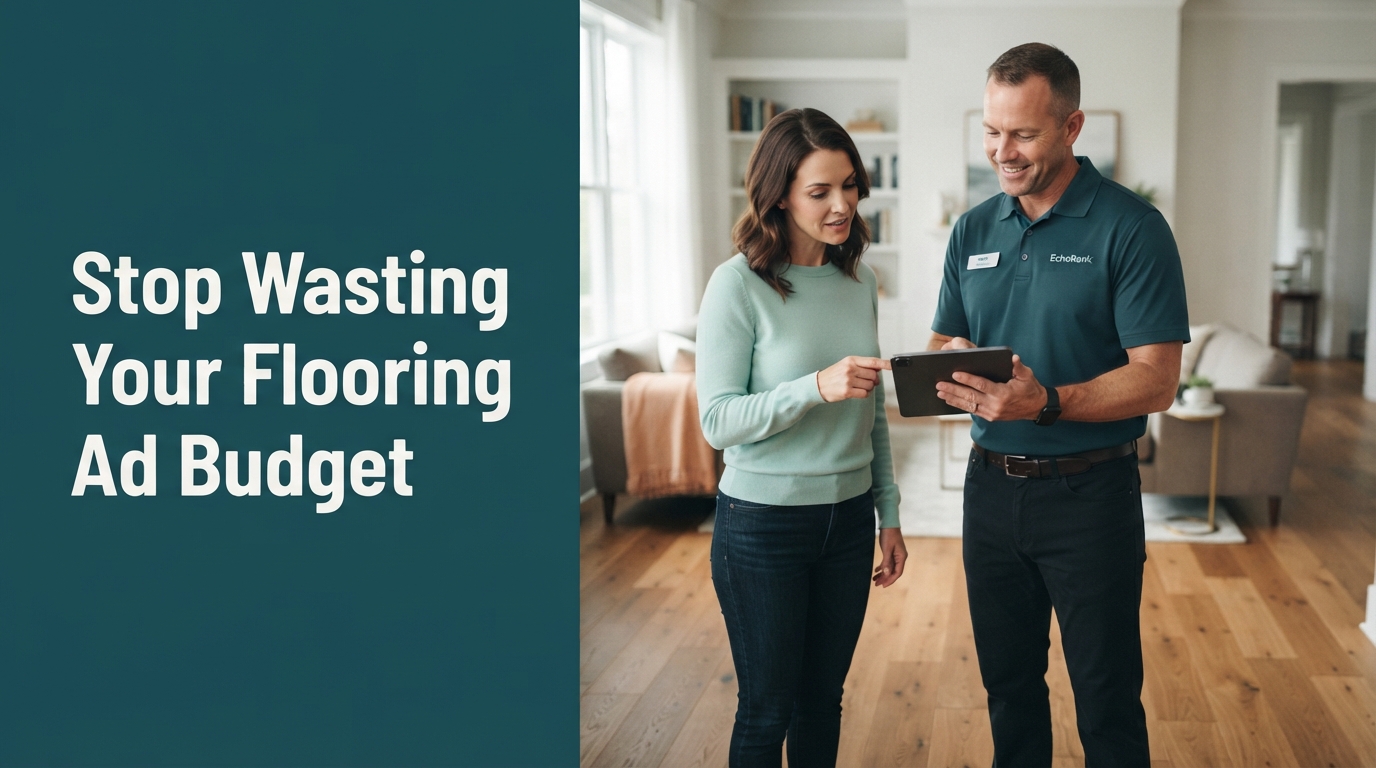
Most flooring contractors lose 40% of their monthly ad budget to 'click-fraud' and low-intent traffic that never results in a booked estimate. You are likely paying for window shoppers rather than homeowners ready to sign a contract for a hardwood or LVP installation project. If your current flooring contractor lead generation strategy feels like a treadmill where you are running fast but staying in the same place, it is time to pivot from volume-based ads to high-intent authority.
Why is my flooring contractor lead generation campaign burning money?
Your campaigns are likely burning money because they target 'flooring' keywords without filtering for intent, leading to high bounce rates from users who only want DIY advice. When you bid on broad terms like 'flooring options' or 'best tile,' you pay for clicks from students, researchers, and out-of-market users who have zero intention of hiring a contractor.
The fundamental issue is the "Search Intent Gap." Most flooring contractors set up Google Ads campaigns using "Broad Match" settings. In the eyes of Google’s algorithm, a user searching for "how to install hardwood flooring" is a potential lead because the keyword "hardwood flooring" is present. However, that user is looking for a YouTube tutorial, not a $15,000 installation contract. By bidding on these terms, you are effectively paying $5 to $15 per click to help a DIYer learn how to use a nail gun.
Furthermore, most flooring business owners fall into the trap of letting Google's automated bidding algorithms optimize for 'conversions' without realizing that those conversions include 'contact us' form fills from spam bots or price-shoppers. If your landing page doesn't explicitly filter for project size or geography, your cost-per-lead (CPL) will remain artificially high while your closing rate stays stuck in the single digits. This is a classic symptom of poor funnel segmentation, where the ad creative promises a generic service rather than a high-ticket local solution.
To visualize the difference between wasted spend and high-intent investment, consider the following breakdown of a typical small-business flooring campaign:
| Campaign Type | Monthly Spend | Clicks | High-Intent Leads | CPL | Closing Rate |
|---|---|---|---|---|---|
| Generic Broad Match | $3,000 | 450 | 4 | $750 | 5% |
| Intent-Filtered Search | $3,000 | 120 | 22 | $136 | 25% |
By narrowing the focus to transactional keywords—such as "hardwood floor installation [City Name]" or "LVP contractor near me"—you reduce your click volume but significantly increase your lead quality. The goal is not to have the most traffic; it is to have the most profitable traffic.
How do I audit my current PPC spend to identify wasted flooring leads?
To audit your spend, analyze your search term report in Google Ads to identify exact matches that resulted in zero inquiries or high bounce rates. Export your last 90 days of data and filter for any search queries that don't include local modifiers like your city or county name, as these are almost always wasted budget.
Begin the audit by categorizing your search terms into three buckets: "Informational," "Comparison," and "Transactional." If more than 30% of your spend is going to "Informational" queries (e.g., "what is the difference between engineered and solid wood"), you are bleeding cash. Use our ROI & PPC Calculator to determine if your current cost-per-acquisition is actually sustainable, or if you are simply subsidizing Google's revenue growth at the expense of your own margins.
Once you have identified these non-converting keywords, map them against your actual closed deals. You will likely find that 80% of your spend is tied to 'informational' queries while only 20% is tied to 'transactional' queries like 'hardwood flooring contractor near me.' According to data from Search Engine Land, granular negative keyword management is the single most effective way to reduce waste in local service campaigns.
Steps to perform a high-impact audit:
- Exclude "DIY" terms: Add negative keywords like "how-to," "DIY," "repair tutorial," "cheap," and "free" to your campaign settings immediately.
- Review Geographic Performance: Open the "Locations" tab in Google Ads. Look for clicks originating from cities outside your service area. If you find consistent traffic from a neighboring town you don't service, exclude those zip codes.
- Analyze Time-of-Day: Check if your ads are running at 3:00 AM. Often, bots and bored researchers click during off-hours. Constrain your ad schedule to business hours when you can respond to leads instantly.
- Audit Landing Page Match: Ensure your ad headline matches the search query. If the user searches for "Luxury Vinyl Plank," they should land on an LVP-specific page, not your generic home page.
Should I stop my local ads to focus on high-intent search assets?
You should not stop your ads entirely, but you must shift 70% of your budget from broad PPC display networks to high-intent search assets that build long-term equity. Instead of paying for every click, invest in your SEO and technical infrastructure to capture users who are actively searching for reputable contractors in your specific service area.
This shift allows you to stop 'renting' your traffic and start 'owning' your visibility. While ads turn off the moment you stop paying, search assets remain, accumulating authority and trust over time. When you invest in SEO, you are building a digital asset that compounds. A well-optimized local landing page can rank for years, whereas an ad campaign is a constant, recurring expense that offers no residual value.
Consider the "Authority Flywheel":
- Content Creation: Write high-quality, local-specific guides (e.g., "The Best Flooring Materials for [City] Humidity").
- Technical SEO: Optimize your site structure so that Google understands exactly where you operate and what you do.
- Backlink Acquisition: Build local partnerships with interior designers, realtors, or general contractors who link to your site.
- Visibility Gains: As your domain authority grows, you capture more "organic" traffic for high-intent keywords, allowing you to gradually lower your PPC budget without losing lead volume.
"Stop treating your website like a digital brochure and start treating it like a high-performance sales engine that works while you sleep."
By moving budget from "Broad PPC" to "Local SEO," you move from a mindset of consumption to a mindset of asset building. This is the difference between a flooring business that struggles every month to "buy" leads and one that naturally attracts high-value projects through authority.
What specific local search signals do flooring customers trust most?
Flooring customers prioritize Google Business Profile (GBP) reviews, local citation consistency, and proximity-based search signals when vetting a contractor. They look for visual proof of your recent work and verified customer testimonials that mention specific flooring materials, such as 'luxury vinyl plank installation' or 'dustless hardwood refinishing.'
Trust is the currency of the home services industry. A homeowner dropping $10,000 on new floors is not looking for the cheapest option; they are looking for the safest one. They want to know that you will show up on time, use quality materials, and not ruin their baseboards.
Beyond simple reviews, your Local SEO Checklist should emphasize geo-tagged photos and consistent NAP (Name, Address, Phone) data across the web. Use our GEO Checker to verify if your site is actually appearing for the specific local terms that drive high-intent homeowners to your booking page. BrightLocal reports that 98% of consumers read online reviews for local businesses, making your reputation management a non-negotiable part of your local search signal strategy.
How to optimize your local signals:
- Review Velocity: Don't just get reviews; get them consistently. A business with 50 reviews from three years ago looks less trustworthy than a business with 20 reviews from the last three months.
- The "Near Me" Factor: Google prioritizes businesses that are physically closest to the searcher. While you cannot change your office location, you can create location-specific pages on your website for each city/neighborhood you serve, which helps Google associate your brand with those specific geographic areas.
- Visual Proof: Upload high-resolution, "before and after" photos to your Google Business Profile. Name the image files with local keywords (e.g.,
hardwood-refinishing-dallas.jpg) before uploading.
How can I use my website to capture leads that ads are currently missing?
Your website should use 'intent-gated' forms and localized landing pages that speak directly to the specific flooring needs of homeowners in your service area. If your landing page is a generic home page, you are missing out on the conversion power of a specific, high-intent landing page designed to solve one problem: getting a flooring estimate.
Most contractors make the mistake of sending traffic to a "Home" page that highlights their history, their mission statement, and their dog. The homeowner doesn't care about your mission; they care about their floors. Your landing page must be a direct response to their problem.
Implement a 3-second conversion funnel that forces a user to choose their flooring type and project size before they see your phone number. This simple hurdle qualifies the lead and ensures that when they do call, they are ready to talk numbers. By asking, "Are you looking for Hardwood, LVP, or Tile?" and "What is your approximate square footage?" you filter out the tire-kickers who aren't serious about a paid installation. This approach is much more effective than finding construction clients for free through random social media networking, as it captures the user at the exact moment of peak intent.
Elements of a high-converting flooring landing page:
- The Hero Section: A clear headline: "Professional Hardwood Installation in [City Name]."
- The "Why Us": Three bullet points explaining your unique value (e.g., "Dustless process," "Lifetime warranty," "Licensed & Insured").
- The Lead Magnet: Offer a "Free Flooring Design Consultation" or "Digital Flooring Project Estimate" rather than just "Contact Us."
- Social Proof: A carousel of recent work photos with captions detailing the material used.
- The Form: Keep it to 3–4 fields maximum. Name, Phone, Email, and Project Type.
Is my current conversion funnel costing me flooring jobs?
Your conversion funnel is likely costing you jobs if it requires more than two clicks to reach a contact form or if the page speed exceeds three seconds. Slow-loading, non-mobile-optimized pages are the primary reason local service businesses lose leads before the user even sees their price point or value proposition.
Modern consumers are impatient. According to Google’s research on mobile latency, as page load time goes from one second to three seconds, the probability of a bounce increases by 32%. If you are paying for an ad click that costs $10, and your site takes four seconds to load, you are essentially lighting your money on fire.
Check your site performance using our Agentic UX & WebMCP Auditor to ensure that your technical foundation is not pushing users toward your competitors. A professional flooring contractor should have a site that feels as premium as the floors they install. If your site looks like it was built in 2012, your customers will assume your installation quality is equally outdated.
Technical Audit Checklist for Flooring Sites:
- Mobile-First Design: 80% of your traffic will come from mobile. If your form is hard to tap or your text is too small to read, your conversion rate will never exceed 1%.
- Clear Call to Action (CTA): Every page should have a "Get Your Free Estimate" button that is visible without scrolling.
- Image Optimization: Ensure your portfolio photos are compressed for web use. High-resolution photos are beautiful, but if they are 10MB each, they will kill your load speed.
- Trust Signals: Ensure your SSL certificate is active (the padlock icon in the browser). If a user sees "Not Secure," they will leave immediately.
If you are ready to stop the bleeding and build a high-conversion digital presence, contact our team today to start your custom audit. We specialize in helping local contractors reclaim their wasted ad spend and turn their websites into the most efficient salesperson on their team.
Key takeaways
- Exclude 'DIY' and 'how-to' search terms to stop paying for non-converting informational traffic.
- Shift 70% of your budget from broad PPC display networks to high-intent local search assets.
- Use location-specific landing pages to improve your relevance and quality score in local search results.
- Implement a 3-second conversion funnel that qualifies leads by project size and material type.
- Increase review velocity to build trust and improve your local search rankings against competitors.
Frequently asked questions
- How do I know if my flooring leads are junk?
- If your leads frequently ask for DIY advice, price-shop without project details, or originate from outside your service area, they are low-intent. Analyze your Google Ads search term report; if more than 30% of your spend goes to informational queries like 'how-to' or 'flooring comparisons,' you are attracting junk leads rather than ready-to-buy homeowners.
- What is a good conversion rate for flooring contractors?
- A healthy conversion rate for a well-optimized flooring contractor landing page typically ranges between 15% and 25%. If your conversion rate is in the single digits, your landing page likely lacks a clear value proposition, has slow load times, or fails to address the specific local needs of homeowners in your area.
- Does Google Business Profile really help with flooring leads?
- Yes, your Google Business Profile is critical for local authority. Because flooring is a high-ticket local service, homeowners rely on proximity and social proof. A profile with recent, consistent reviews and geo-tagged project photos signals to Google that you are a trusted, active local business, which directly improves your ranking in map results.
- Should I use Google Ads or SEO for flooring?
- You should use both in a balanced strategy. Use high-intent PPC to capture immediate, urgent demand in your service area, while investing in SEO to build long-term, organic visibility. Over time, as your SEO authority grows, you can reduce your reliance on paid ads, lowering your overall cost-per-lead while maintaining a steady flow of high-quality inquiries.
Sources & references

Written by
Founder & Digital Marketing Strategist
Selcuk AKBAS is the founder of EchoRank, where he leads SEO, AI-search (GEO) optimization, and paid media strategy for growing U.S. businesses. Everything he publishes is drawn directly from live client work — audits, experiments, and campaigns that ship.
- Google Ads Search Certification
- Google Analytics Certification