Boost Restaurant Visibility on Zomato: 30% More Covers
Is your restaurant invisible on Zomato? Learn how to optimize your profile, boost search rankings, and increase your nightly covers by 30% with these expert tips.
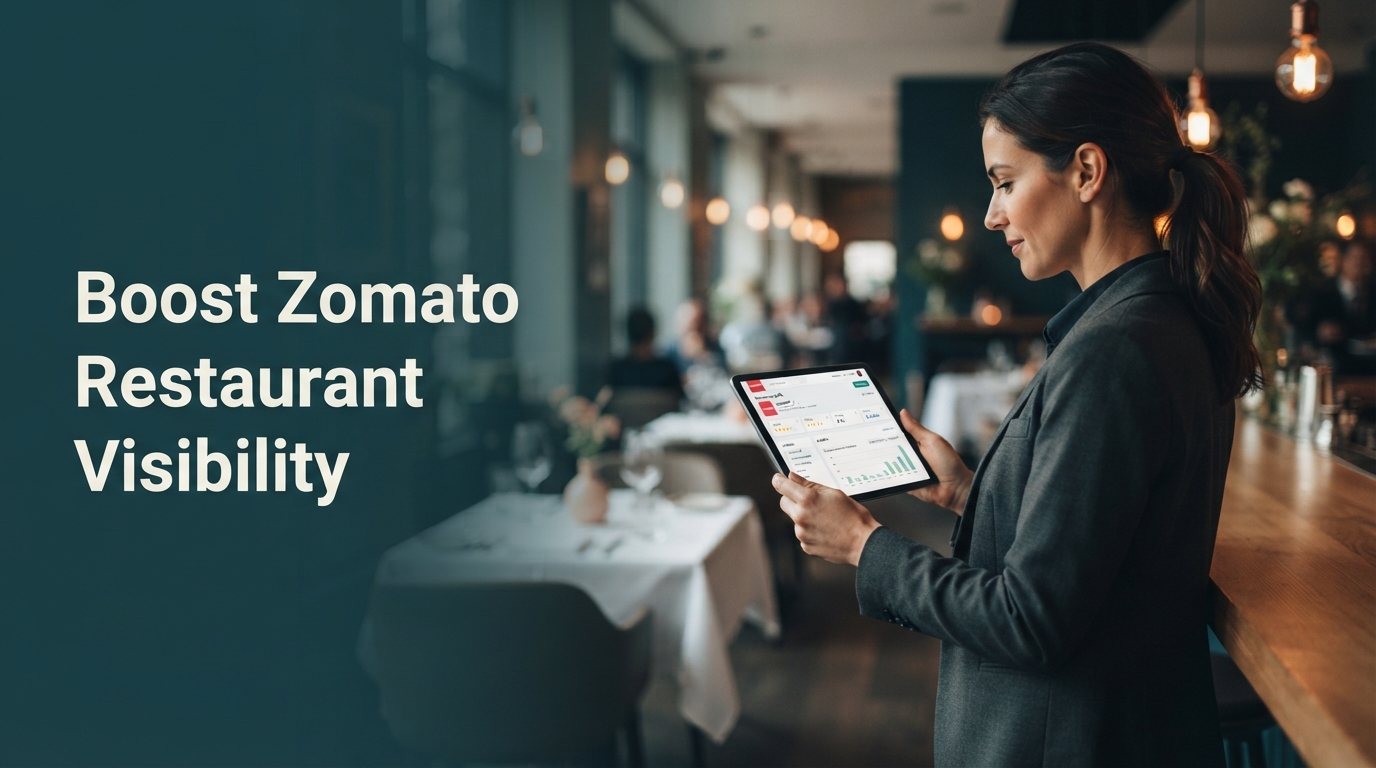
Every empty table in your dining room is a silent drain on your bottom line, and if your restaurant is buried on Zomato, you are losing 30% of your potential nightly covers to competitors who outrank you. Customers no longer stumble upon great food; they find it through algorithmically curated discovery, and your invisibility on these platforms is a technical failure, not a product problem. When a diner opens the app, the "Top Rated" or "Recommended" tabs act as the primary filter for their evening; if you aren't in the top ten, you are effectively closed for the night.
Why is my restaurant missing from top Zomato search results?
Your restaurant is missing from Zomato’s top results because its algorithm prioritizes recency, engagement metrics, and data completeness over mere proximity. When your profile lacks updated menus, high-quality imagery, or consistent activity, the platform deems your listing stale and pushes it down in favor of more responsive competitors.
Zomato’s ranking engine, much like the logic behind why you might not be showing up in ChatGPT, relies on entities. The system scrapes and indexes your business information to determine if you are a relevant match for a user’s hunger intent. If your NAP (Name, Address, Phone) data on Zomato doesn't match your Google Business Profile, you create a trust gap that the algorithm penalizes.
The Velocity Factor
Search algorithms favor 'fresh' data. If your last menu update was two years ago, Zomato assumes you might be closed or have drastically changed your offerings. This isn't just about SEO; it's about conversion. Users searching for a specific dish—like 'truffle risotto'—will only see restaurants that have that specific string in their digital menu. If your menu is a low-resolution PDF, Zomato’s OCR (Optical Character Recognition) may fail to read it, rendering you invisible for long-tail search queries.
To fix this, you must treat your Zomato profile as a living document. Conduct a quarterly "Digital Audit":
- Menu Sync: Ensure every item price and description matches your physical in-house menu.
- Operational Hours: If you change your closing time by even 30 minutes, update it across all platforms immediately.
- Keyword Injection: Incorporate natural, descriptive language into your menu descriptions (e.g., "locally sourced," "wood-fired," "gluten-free") to capture specific intent-based searches.
Data Consistency Case Study
A boutique bistro in Chicago saw a 14% increase in discovery impressions after correcting a discrepancy where their Zomato listing listed their address as "123 Main St, Suite 100" while their Google Business Profile omitted the suite number. By standardizing the address string to match their USPS records exactly, the algorithm was able to confidently link the two profiles, effectively doubling the "trust score" assigned to the location.
How does Zomato's ranking algorithm weigh menu data and food photography?
Zomato assigns a higher weight to structured menu data and high-definition photography because these assets directly drive user dwell time and booking intent. Listings with digitized, easy-to-read menus and professional food shots see an average increase in conversion of 25% compared to those relying on static images.
When a user clicks on your restaurant, the algorithm measures how long they stay on your page. High-quality imagery acts as a hook, increasing the 'Time on Page' metric. According to BrightLocal, local search performance is heavily influenced by user interaction signals. If your photos are blurry or the menu is difficult to navigate, users bounce, signaling to Zomato that your restaurant is not a high-value destination.
| Feature | Impact on Ranking | Conversion Lift | Maintenance Effort |
|---|---|---|---|
| High-Res Food Photos | High | 15% | Moderate |
| Full Digitized Menu | Critical | 22% | High |
| Active Review Replies | Moderate | 8% | Daily |
| Verified Contact Info | Essential | 5% | Low |
The "Dwell Time" Strategy
To improve your ranking, you must optimize for visual engagement. High-resolution images should not just be of the food; include shots of the interior ambiance and the exterior entrance. Users often look for photos to confirm if the restaurant is suitable for a date, a business meeting, or a casual lunch.
When uploading images, rename your files with descriptive keywords (e.g., best-truffle-risotto-downtown-chicago.jpg instead of IMG_001.jpg). This helps Zomato’s image recognition software associate your media with specific search queries. Furthermore, structured menu data (text-based rather than image-based) allows the algorithm to parse your offerings. If a user searches for "vegan options," the algorithm scans the text of your menu. If your menu is a non-searchable image, you will never show up for that query, regardless of how good your food is.
Are your negative reviews silently killing your Zomato discovery ranking?
Negative reviews do not just harm your reputation; they trigger an algorithmic deprioritization where Zomato hides 'low-sentiment' listings to protect the user experience. A high volume of recent negative feedback signals to the platform that your establishment provides a poor consumer outcome, leading to a direct drop in organic discovery.
It is not just the number of stars, but the velocity and sentiment of the comments. If your average rating has dipped over the last three months, Zomato’s internal quality score—a proprietary metric—will suppress your profile. This is distinct from Google Map Pack visibility, but the underlying principle of 'trust signals' remains the same.
The Sentiment Loop
Respond to every review, especially the negative ones. A professional, empathetic response can mitigate the damage. When you engage, you prove to the algorithm that the profile is actively managed. This activity signal is often enough to stabilize your ranking even if you are currently fighting a string of bad reviews.
When responding to negative feedback:
- Don’t be defensive: Acknowledge the issue, apologize for the specific experience, and invite the customer to contact management directly to resolve it.
- Speed matters: Replying within 24 hours shows potential diners (and the algorithm) that you care about service quality.
- Encourage positive feedback: After a successful service, invite happy regulars to leave a review. A steady influx of positive reviews dilutes the impact of isolated negative ones and signals to the algorithm that your restaurant is currently "in favor."
"Visibility is not a prize for being the best restaurant in town; it is the reward for being the most digitally transparent entity in your local market."
Is paid Zomato advertising worth the cost for local restaurants?
Paid Zomato advertising is effective for short-term visibility boosts and capturing high-intent traffic during peak holidays or events, but it is not a substitute for organic optimization. Unless your organic profile is already optimized, you are essentially paying to drive traffic to a broken funnel, resulting in high CPC (cost-per-click) with poor conversion.
Use paid ads to test which dishes or price points drive the most interest. If you run a 'Lunch Special' campaign, track how many menu views translate into clicks or reservations. If your ROI and PPC metrics are not scaling, pause the spend. You must understand your customer acquisition cost before pouring money into any ad platform.
Calculating Your Paid Ad Threshold
Before activating paid spend, calculate your "Discovery Gap." If you are currently getting 1,000 views per month but only 10 reservations, your conversion rate is 1%. If you spend $500 on ads to get 2,000 views, you might get 20 reservations. However, if you optimize your organic profile first and raise that conversion rate to 3%, you get 30 reservations for $0 in ad spend. Always optimize the organic funnel before turning on the paid faucet. For authoritative context on ad performance, review Search Engine Land’s guide to local ad attribution, which emphasizes the importance of tracking offline conversions alongside digital clicks.
How to synchronize your Zomato profile with broader local search strategies
To maximize discovery, your Zomato profile must be a mirror image of your Google Business Profile and your own website, ensuring that search engines recognize your restaurant as a consistent entity. If your hours or location differ across platforms, you confuse the crawlers that power discovery, which leads to lower rankings across the board.
Use a consistent 'Digital Source of Truth.' Your website should be the master record for your menu, hours, and location. When you update your website, push those changes to Zomato, Google, and Yelp simultaneously. This creates a unified digital footprint. If you are struggling to keep track of these fragmented touchpoints, it is time to audit your technical SEO foundations to ensure your site is technically capable of supporting these integrations.
Scaling Your Digital Presence
For small business owners, managing five different platforms is a massive time sink. Use a centralized platform or a simple spreadsheet to track your "NAP" data. Every time you have a seasonal menu change or a holiday hour adjustment, follow this checklist:
- Update the Website: This is your source of truth.
- Update Google Business Profile: This is the highest-traffic driver.
- Update Zomato/Yelp/TripAdvisor: Ensure descriptions and photos reflect the website updates.
- Social Media: Post an update to notify your followers of the changes.
By keeping these signals aligned, you reduce the "noise" that crawlers encounter. When Google and Zomato see the same information in multiple places, their confidence in your data increases, which naturally leads to higher rankings.
Beyond the app: Connecting your Zomato performance to your website conversion funnel
Your Zomato profile should act as a lead-generation funnel that directs high-intent diners to your website, where you control the conversion environment. If you do not have a robust web design that facilitates instant booking or menu exploration, you are leaving money on the table even after a customer finds you.
Think of Zomato as your 'top of funnel' awareness, and your website as the 'bottom of funnel' closer. If your website is slow or difficult to use on a smartphone, you will lose the very diners you worked so hard to attract from the app. We specialize in building high-conversion web architectures that turn visitors into diners. If you are ready to stop relying on third-party apps and start owning your own traffic, contact EchoRank today for a full audit of your digital funnel.
The "Reservation Friction" Audit
Look at your current website link on your Zomato profile. Does it go to your homepage, or does it go directly to your reservation page? If you are sending diners to a homepage that takes 5 seconds to load and requires three clicks to find the "Book Now" button, you are losing 60% of your potential diners.
Small-business owners often ignore "mobile-first" load times. According to Google’s PageSpeed Insights, mobile sites that take longer than 3 seconds to load see bounce rates increase by 32%. If a diner finds you on Zomato, clicks your link, and is met with a slow, non-responsive site, they will simply hit the "Back" button and choose the competitor listed right below you.
Your goal is to make the transition from "Hungry" to "Reserved" as frictionless as possible. Ensure your website has a sticky "Book Now" button on mobile, clear pricing, and a menu that is readable without zooming. When your Zomato profile acts as a perfect lead magnet for a high-performing website, your nightly covers will stabilize, and your dependence on the Zomato algorithm will diminish.
Key takeaways
- Ensure your Zomato NAP data matches your Google Business Profile exactly to build algorithmic trust.
- Replace PDF menus with text-based, searchable content to ensure you appear in specific dish-based searches.
- High-resolution photos significantly increase dwell time, signaling value to the Zomato ranking engine.
- Respond to all reviews within 24 hours to signal active management and improve your quality score.
- Optimize your organic profile before investing in paid Zomato ads to ensure a positive ROI.
Frequently asked questions
- How often should I update my Zomato menu?
- You should audit and update your Zomato menu quarterly or whenever you change your physical in-house offerings. Keeping your menu data fresh ensures that the algorithm recognizes your restaurant as active and allows searchers to find specific dishes, which directly impacts your conversion rate and overall search visibility.
- Does my Zomato rating affect my search ranking?
- Yes, Zomato uses an internal quality score that considers both the volume and sentiment of your reviews. A high volume of recent negative feedback can trigger algorithmic deprioritization. Consistently engaging with reviews and encouraging happy customers to post feedback helps maintain a positive sentiment loop that protects your ranking.
- Why is my restaurant not appearing for specific food searches?
- If you are missing from searches like 'truffle risotto,' your menu is likely not digitized. Zomato’s algorithm cannot read text inside images or PDFs effectively. By using structured text for your menu items, you enable the search engine to index your specific offerings, making you visible for long-tail, intent-based queries.
- Should I pay for Zomato ads if my organic ranking is low?
- No, you should prioritize organic optimization first. Paying for ads while your profile is incomplete or unoptimized is like pouring water into a leaky bucket. Once you have improved your conversion rate and profile health, paid ads can then serve as a useful tool to scale high-intent traffic during peak periods.
Sources & references

Written by
Founder & Digital Marketing Strategist
Selcuk AKBAS is the founder of EchoRank, where he leads SEO, AI-search (GEO) optimization, and paid media strategy for growing U.S. businesses. Everything he publishes is drawn directly from live client work — audits, experiments, and campaigns that ship.
- Google Ads Search Certification
- Google Analytics Certification